




1. Definition and Classification of Beverages
According to the current National Food Safety Standard – Beverages, a beverage (also known as a drink) refers to a quantitatively packaged product made from one or more edible raw materials, with or without added auxiliary materials, food additives, and food nutrition fortifiers, processed for direct drinking or reconstitution, and with an ethanol content not exceeding 0.5% by mass. The main categories include carbonated drinks, fruit and vegetable juice drinks, protein drinks, packaged drinking water, tea drinks, coffee drinks, solid drinks, special-purpose drinks, plant drinks, flavored drinks, and other drinks.
2. Production Process Flow of Carbonated Drinks
2.1 Key Control Points in Carbonated Drink Production
-
Water Quality and Syrup: The water must be softened and sterilized, with a hardness ≤ 50mg/L. The syrup Brix needs to be accurately controlled within a deviation of ±0.1°, and the feeding sequence and hygiene are the basis for stable flavor.
-
Carbonation: The core is low temperature (0-4℃) and stable pressure. Precisely control the CO₂ pressure to ensure stable gas content (e.g., 3.5-4.0 Vol), preventing inconsistent taste or “flash evaporation”.
-
Filling and Sealing: Isobaric filling is adopted to prevent bottle explosion and CO₂ loss. Strictly monitor the capping torque and sealing performance, which is the final barrier to prevent air leakage and microbial contamination.
2.2 Flavoring Timing for Carbonated Drinks
-
Flavoring Process: Flavoring is carried out during the blending and mixing process.
-
Temperature Control: The mixing temperature is controlled below 20℃ to reduce flavor volatilization and microbial growth.
-
Flavoring Timing: Pay attention to the feeding sequence, which is usually: sugar/sweetener → preservative → acidulant → flavor → pigment → add water to constant volume, and stir thoroughly to mix evenly. Incorrect sequence may cause reactions between components to produce precipitation (e.g., reaction between acidulant and sodium benzoate to form benzoic acid precipitation).
3. Production Process Flow of Fruit Juice Drinks
3.1 Key Control Points in Fruit Juice Drink Production
-
Raw Material Quality: Strictly control the freshness and microbial indicators of base materials such as concentrated fruit juice.
-
Sterilization Process: Precisely control the sterilization temperature and time (e.g., 95℃/30s) to ensure commercial sterility.
-
Filling and Sealing: Ensure hot filling temperature (≥85℃) or sterile environment, as well as capping tightness, to prevent secondary contamination.
3.2 Flavoring Timing for Fruit Juice Drinks
-
Flavoring Process: Flavoring is carried out in the later stage of the blending and mixing process.
-
Temperature Control: The mixing temperature is controlled below 30℃ to reduce flavor volatilization and aroma loss.
-
Correct Sequence: It must be added after the acidulant (e.g., citric acid). Because most flavors are esters, which are prone to hydrolysis in an acidic environment, leading to flavor distortion and failure. Fully diluting the acidulant first can avoid local over-acidity of the flavor. Stir thoroughly to mix evenly after adding the flavor.
4. Production Process Flow of Solid Drinks (Powdered)
4.1 Key Control Points in Solid Drink Production
-
Raw Material Control: Strictly inspect the microbial indicators of powdered raw materials to eliminate pollution sources.
-
Sterilization Process: Adopt irradiation, thermal or other methods to effectively kill pathogenic bacteria and ensure safety. The common method for solid drinks is irradiation sterilization: send the whole box of finished products to the irradiation workshop for sterilization.
-
Mixing Uniformity: Ensure that trace additives (flavors, nutrients) are completely evenly distributed.
-
Packaging Moisture Proof: Quickly complete sealed packaging in a low-humidity environment to prevent moisture absorption, caking and deterioration.
4.2 Flavoring Timing for Solid Drinks
-
Flavoring Process: Flavoring is carried out in the later stage of the mixing process. After the main basic raw materials such as powdered sugar and milk powder, as well as other trace components (e.g., acidulants, pigments) have been basically mixed evenly, add the flavor last and mix for a short time to ensure uniform distribution.
-
Temperature Control: Low-temperature environment to avoid flavor volatilization caused by high temperature.
-
Notes: Uniform Dispersion – Use a small amount of auxiliary materials (e.g., powdered sugar) for pre-mixing and dilution to prevent agglomeration or uneven distribution; Sealed Moisture Proof – Many flavors (especially liquid flavors) are hygroscopic, and subsequent operations need to be sealed quickly to prevent moisture absorption and aroma loss.
5. Basic Principles for Selecting Flavors for Beverages
-
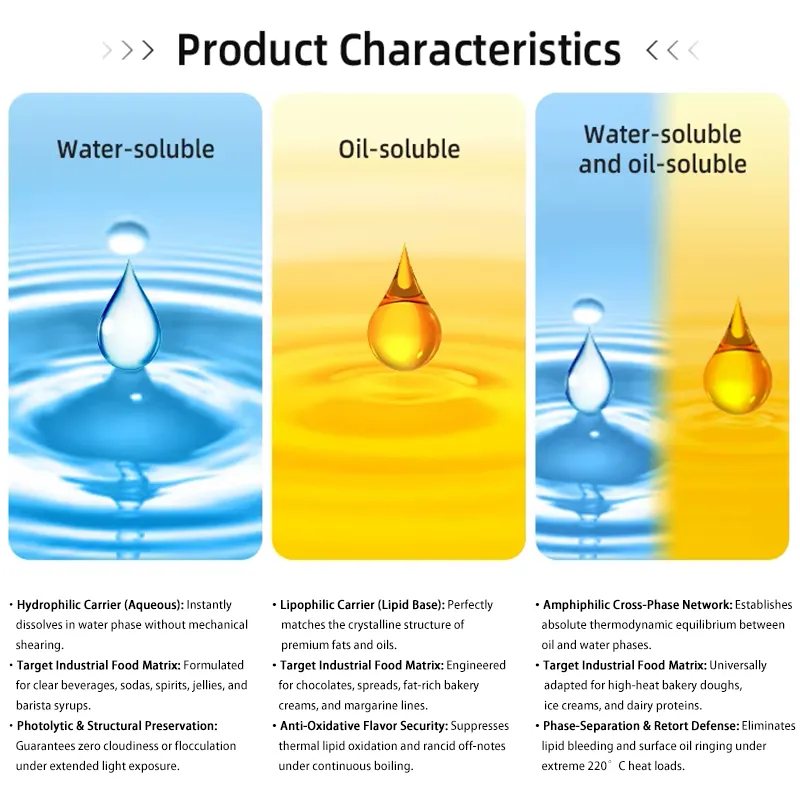
Generally, choose edible sweet flavor flavors: Theoretically, the company’s edible sweet water-soluble flavors, water-oil dual-purpose flavors, emulsified flavors, powder flavors, etc., are all suitable for flavoring in beverages. Usually, beverages have low requirements on the temperature resistance of flavors.
-
In actual operation, the selection of the properties of flavor products should be based on the type of beverage product and combined with the customer’s specific production process. For example, carbonated drinks, fruit juice drinks, etc., prefer the company’s water-soluble flavors as the first choice; solid drinks prefer the company’s powder flavors as the first choice.
-
Recommended dosage of flavors for beverages: 0.08%~0.12%
6. Common Product Quality Problems and Main Causes in Beverage Enterprises
-
Spoilage: Cause: Incomplete sterilization (insufficient temperature/time), microbial contamination due to inadequate cleaning and disinfection of equipment, secondary contamination due to poor packaging tightness or inadequate sterilization of bottle caps.
-
Precipitation and Stratification: Cause: High water hardness, unreasonable formula and process (e.g., charge imbalance of fruit juice/protein drinks), poor homogenization effect, or improper selection/ dosage of stabilizers.
-
Flavor Distortion: Cause: Improper selection of flavors and fragrances or wrong addition timing, oxidative browning of raw materials (e.g., fruit juice), excessive sterilization leading to cooking taste, and odor migration from packaging materials.
-
Carbonated Drinks “Losing Gas”: Cause: Insufficient CO₂ purity, too low gas content, loss caused by out-of-control pressure and temperature during filling, poor bottle cap tightness or tiny leaks in the bottle body.
-
Visible Foreign Bodies: Cause: Impurities in raw materials, uncleaned equipment and pipelines, unwashed bottles or caps, and improper dust control in the production environment.
7. Recommended High-Quality Flavor Products for Beverages of the Company
|
Model
|
Product Name
|
Property
|
Color
|
Aroma Description
|
Product Features
|
|---|---|---|---|---|---|
|
150011
|
Orange Flavor
|
Water-soluble
|
Colorless to pale yellow
|
Rich orange aroma
|
Has the sweetness of orange juice
|
|
100113
|
Peach Flavor
|
Water-soluble
|
Colorless
|
Rich peach aroma
|
The sweet and sour taste of peach is prominent
|
|
100048
|
Lemon (XB) Flavor
|
Water-soluble
|
Colorless
|
Standard lemon-lime aroma
|
Strong lemon flavor
|
|
100085
|
Green Apple Flavor
|
Water-soluble
|
Colorless
|
Pure green apple aroma
|
Less sweetness, prominent green apple flavor
|
|
100094
|
Strawberry Flavor
|
Water-soluble
|
Colorless
|
Fresh and sweet strawberry aroma
|
Rich sweet and fragrant strawberry taste
|
|
100739
|
Sweet Corn Flavor
|
Water-soluble
|
Colorless
|
Fresh tender corn aroma
|
Prominent corn sweetness
|
|
100642
|
Black Tea Flavor
|
Water-soluble
|
Colorless
|
Rich black tea aroma
|
Obvious black tea flavor
|
|
150652A
|
Green Tea Flavor
|
Water-soluble
|
Colorless to pale yellow
|
Pure green tea aroma
|
Strong green tea flavor
|
|
100134
|
Sour Plum Flavor
|
Water-soluble
|
Colorless
|
Pleasant sweet and sour plum aroma
|
Prominent sour plum flavor
|
|
100074
|
Pineapple Flavor
|
Water-soluble
|
Colorless
|
Unique fresh ripe pineapple aroma
|
Relatively prominent ripe sweet pineapple flavor
|
|
100333
|
Red Date Flavor
|
Water-soluble
|
Reddish brown
|
Pure Cangzhou red date aroma
|
Rich sweet and fragrant red date taste
|
|
100603
|
Sweet Osmanthus Flavor
|
Water-soluble
|
Colorless
|
Elegant and light osmanthus aroma
|
Strong osmanthus aroma
|
|
191602
|
Tamarind Flavor
|
Water-soluble
|
Dark brown
|
Strong sour tamarind aroma
|
Prominent sour tamarind flavor
|
|
390091
|
Strawberry Flavor
|
Water-oil dual-purpose
|
Colorless
|
Fresh and clean strawberry aroma
|
Rich sweet and fragrant strawberry taste
|
|
390113
|
Peach Flavor
|
Water-oil dual-purpose
|
Colorless
|
Realistic sweet aroma and peach pulp aroma
|
Rich sweet and fragrant peach taste
|
|
390261
|
Mango Flavor
|
Water-oil dual-purpose
|
Colorless
|
Sweet ripe mango pulp texture aroma
|
Moderate sweetness
|
|
300132
|
Dark Plum Flavor
|
Water-oil dual-purpose
|
Dark brown
|
Typical dark plum aroma
|
Strong dark plum aroma
|
|
300121
|
Hawthorn Flavor
|
Water-oil dual-purpose
|
Light brown
|
Fresh sweet and sour hawthorn juice aroma
|
Prominent sour taste, less sweetness
|
|
300821
|
Blueberry Flavor
|
Water-oil dual-purpose
|
Colorless
|
Pure blueberry juice aroma
|
Relatively prominent blueberry sweet and sour taste
|
|
301361
|
Wolfberry Flavor
|
Water-oil dual-purpose
|
Colorless
|
Sweet wolfberry dry aroma
|
Obvious sweet and fragrant wolfberry taste
|
|
390661
|
Oolong Tea Flavor
|
Water-oil dual-purpose
|
Colorless to pale yellow
|
Realistic oolong tea aroma
|
Unique oolong tea flavor
|
|
390733
|
Mixed Fruit Flavor
|
Water-oil dual-purpose
|
Colorless
|
Compound fruit aroma with banana, pineapple and plum
|
Rich compound fruit aroma
|
|
300374
|
HN Functional Beverage Flavor
|
Water-oil dual-purpose
|
Colorless to pale yellow
|
Fresh and sweet compound fruit aroma
|
Unique Red Bull flavor
|
|
390182
|
Coconut Juice Flavor
|
Water-oil dual-purpose
|
Colorless
|
Coconut juice aroma with coconut oil and coconut meat
|
Obvious coconut meat aroma, less sweetness
|
|
C16001
|
Apricot Flavor
|
Water-oil dual-purpose
|
Colorless
|
With apricot pulp flavor characteristics
|
Unique flavor, suitable for health drinks
|
|
C0122813
|
Candied Hawthorn Flavor
|
Water-oil dual-purpose
|
Colorless
|
Sweet and sour hawthorn aroma
|
More sour taste and less sweet taste of hawthorn
|
|
C0941901
|
Passion Fruit Flavor
|
Water-oil dual-purpose
|
Colorless
|
Tropical fruit aroma unique to juice
|
Prominent sweet and fragrant passion fruit taste
|
|
C0430101
|
Ginseng Flavor
|
Water-oil dual-purpose
|
Colorless
|
Strong characteristic aroma of Chinese ginseng
|
Strong sweet aroma of ginseng
|
|
C0401903
|
Buckwheat Flavor
|
Water-oil dual-purpose
|
Colorless
|
With burnt aroma, roasted aroma, grain aroma and sweet aroma
|
Relatively obvious roasted aroma
|
|
400023
|
Emulsified Orange Flavor
|
Emulsified
|
Orange red
|
Sweet mandarin orange aroma
|
Rich sweet and fragrant orange taste
|
|
500334
|
Red Date Powder Flavor
|
Powdered
|
Pale yellow
|
Aroma like fresh big red dates
|
Rich sweet and fragrant red date taste
|
|
500013
|
Orange Powder Flavor
|
Powdered
|
Pale yellow
|
Rich orange aroma
|
Prominent orange sweet and sour taste
|
|
500071
|
Pineapple Powder Flavor
|
Powdered
|
White
|
Unique fresh pineapple aroma
|
Prominent fresh pineapple flavor, less sweetness
|
|
500062A
|
Banana Powder Flavor
|
Powdered
|
White
|
Rich ripe banana pulp aroma
|
Relatively rich sweet and fragrant banana taste
|
|
500853
|
Ginger Juice Powder Flavor
|
Powdered
|
White
|
Pure ginger juice aroma
|
Prominent spicy taste of ginger juice
|
|
F0020801
|
Orange Powder Flavor
|
Powdered
|
Pale yellow
|
Natural, fresh orange aroma
|
Rich sweet and fragrant orange taste
|